
Fiberglass Roof Tiles: Complete Buyer, Engineering & Installation Guide in Pakistan
Fiberglass Roof Tiles give engineers, facility managers, and commercial buyers across Islamabad, Lahore, Murree, Abbottabad, and Karachi a high-strength, weather-proof solution built for Pakistan’s toughest thermal and industrial conditions. Homeowners in DHA Lahore, Bahria Town Islamabad, and the hill stations of Murree love the Mediterranean look of clay Spanish roof tiles—until a winter hailstorm cracks dozens of clay tiles and water starts dripping through the ceiling slab. Fiberglass roof tiles are continuous molded GRP panels that replicate the classic three-dimensional profile of Spanish barrel tiles or Roman step tiles while eliminating the fragility, heavy dead weight, and hundreds of leak-prone joints of individual clay tiles. Manufactured by Industrial Techno International (ITI Engineering) in Pakistan, these composite tile sheets install rapidly over light steel purlins and stay watertight through torrential rain, hail, and high winds. By combining proven principles of glass-reinforced composite roofing materials with precision local fabrication, projects that specify GRP Spanish roof tiles Pakistan gain decades of dependable service without recurring repair shutdowns.
What Are Fiberglass Roof Tiles and Why Are Buyers in Pakistan Switching to Engineered Solutions?
Direct Answer: Compared with unverified bazaar alternatives or slow masonry builds, factory-engineered Fiberglass Roof Tiles cut on-site installation time by up to 50% while eliminating rust, water seepage, and structural fatigue. Across Islamabad, Lahore, Murree, Abbottabad, and Karachi, facility owners and consultants specify GRP Spanish roof tiles Pakistan and terracotta style fiberglass roofing to protect capital budgets over a 25-year lifecycle.
Individual clay Khaprail tiles shift under wind uplift, nest birds and wasps in gaps, absorb rainwater that adds tons of wet weight to the roof, and shatter whenever maintenance workers step on the roof to clean gutters or service AC units. By molding continuous step-tile waves out of 2.5 mm to 4.0 mm reinforced fiberglass laminate, ITI Engineering preserves the deep shadow lines of traditional terracotta tiles while creating a monolithic, walkable, leak-free roof membrane. When projects also require complementary systems like corrugated and flat fiberglass sheets or fiberglass skylight sheets for roofs, coordinating engineering specs upfront guarantees matching thermal expansion and wind-load safety.
Field reliability in Islamabad, Lahore, Murree, Abbottabad, and Karachi depends on matching raw material chemistry to real Pakistani operating conditions—from 50°C summer peaks to coastal humidity. As a dedicated manufacturer and supplier, Industrial Techno International (ITI Pakistan) engineers fiberglass roof tiles with the same strict quality control applied to our fiberglass storage vessels, FRP walkways, roof skylight sheets, portable site offices, and welded steel structures, giving buyers direct factory traceability.
What Technical Specifications Should You Verify Before Ordering Fiberglass Roof Tiles?
Direct Answer: Before issuing a purchase order for Fiberglass Roof Tiles, verify six core metrics: structural material grade, UV/corrosion surface barrier thickness, load-bearing gauge or gsm weight, thermal rating, fastener specification, and dimensional tolerances. Locking these into your BOQ prevents underweight substitutions on lightweight roof tiles Lahore.
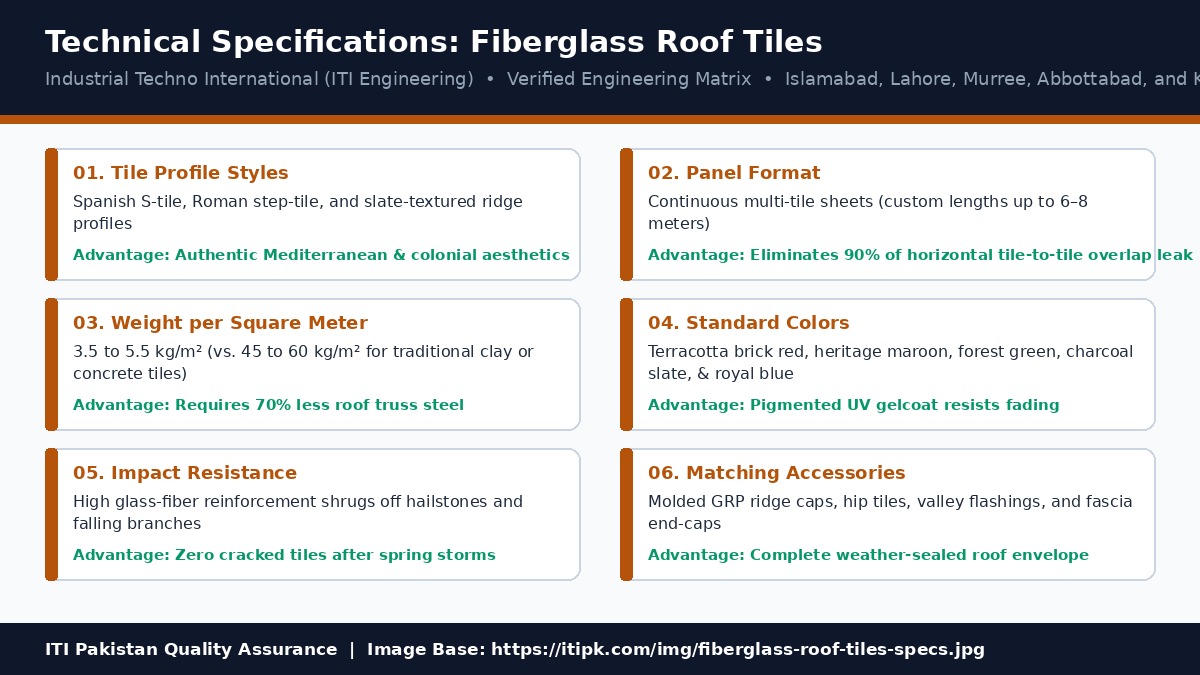
| Engineering Parameter | ITI Engineering Standard Specification | Operational & Buyer Advantage |
|---|---|---|
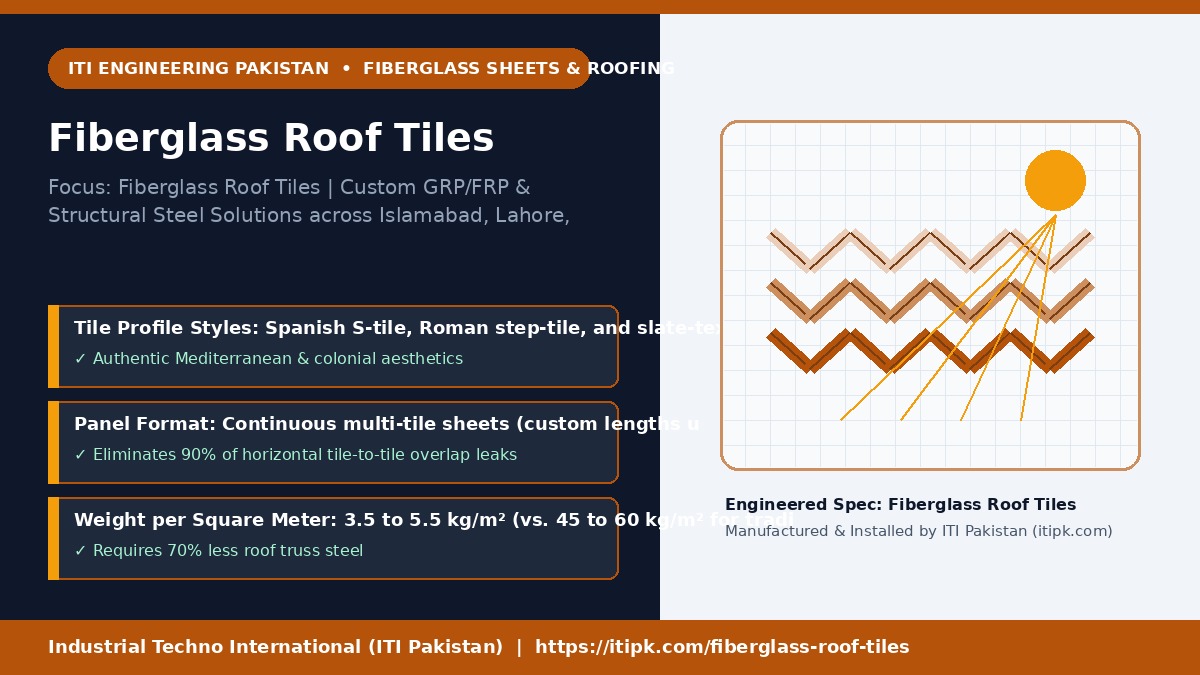
| Tile Profile Styles | Spanish S-tile, Roman step-tile, and slate-textured ridge profiles | Authentic Mediterranean & colonial aesthetics |
| Panel Format | Continuous multi-tile sheets (custom lengths up to 6–8 meters) | Eliminates 90% of horizontal tile-to-tile overlap leaks |
| Weight per Square Meter | 3.5 to 5.5 kg/m² (vs. 45 to 60 kg/m² for traditional clay or concrete tiles) | Requires 70% less roof truss steel |
| Standard Colors | Terracotta brick red, heritage maroon, forest green, charcoal slate, & royal blue | Pigmented UV gelcoat resists fading |
| Impact Resistance | High glass-fiber reinforcement shrugs off hailstones and falling branches | Zero cracked tiles after spring storms |
| Matching Accessories | Molded GRP ridge caps, hip tiles, valley flashings, and fascia end-caps | Complete weather-sealed roof envelope |
The mechanics of architectural roof structures explain why wall thickness and reinforcement density are non-negotiable when evaluating bids for weatherproof FRP step tiles: because flexural stiffness scales with the cube of thickness, a 15% thinner section loses nearly 40% of its bending resistance. ITI Engineering documents exact millimeter gauges and resin systems on every batch, whether ordered standalone or integrated with custom fiberglass sheds.
How Does Composite Laminate Chemistry Determine Real-World Lifespan?
Not all fiberglass performs equally—a lesson many buyers in Islamabad, Lahore, Murree, Abbottabad, and Karachi learn when a cheap unit turns chalky within two summers. When specifying Fiberglass Roof Tiles or comparing quotes for GRP Spanish roof tiles Pakistan, longevity depends on the three-layer GRP cross-section: a 400–600 micron UV-stabilized NPG isophthalic gelcoat on the outside, a fine surface veil, and alternating plies of virgin E-glass chopped strand mat (300–450 gsm) and woven roving (600 gsm). While chopped mat prevents inter-laminar shear across terracotta style fiberglass roofing and lightweight roof tiles Lahore, continuous woven roving acts like internal rebar against wind uplift and hail impact. Unlike bazaar fabricators who dilute orthophthalic resin with brittle calcium carbonate chalk filler, ITI Engineering uses pure thermoset resins that never peel or crack.
How Do Thermal Expansion and Monsoon Moisture Affect Installation?
Across Islamabad, Lahore, Murree, Abbottabad, and Karachi, surface temperatures swing from winter frost to over 52°C in June. High-expansion plastics like PVC or thin polycarbonate elongate screw holes and break seals, whereas glass-reinforced composites in our Fiberglass Roof Tiles expand at nearly the same low rate as structural steel. When our teams integrate polyurethane (PU) foam cores or steel mounting plates for weatherproof FRP step tiles and porch and gazebo fiberglass tiles, every insert is fully encapsulated in resin so monsoon moisture never wicks inside.
Where Are Fiberglass Roof Tiles Used Most Effectively Across Pakistan?
Direct Answer: Across Pakistan’s industrial estates, commercial plazas, housing societies, and infrastructure camps, Fiberglass Roof Tiles are deployed wherever owners need weather immunity, fast installation, and low lifecycle cost—from coastal Karachi and Port Qasim to high-heat corridors in Lahore, Faisalabad, Multan, and Hattar.
- Application 1: Sloped porch roofs, bay window hoods, and Spanish-style villa facades in Lahore, Islamabad, and Rawalpindi.
- Application 2: Hill-station cottages and resorts in Murree, Nathia Gali, and Swat needing snow-shedding, hail-proof roofs.
- Application 3: Garden gazebos, clubhouses, and housing society entrance gates requiring upscale architectural roofing.
- Application 4: Commercial restaurants and boutique plazas upgrading street-facing canopy aesthetics.
Field Execution: Upgrading Facilities Without Production Downtime
In a typical facility upgrade in Islamabad, Lahore, Murree, Abbottabad, and Karachi, operations teams must install Fiberglass Roof Tiles without halting daily shifts. Because ITI Engineering pre-fabricates modules in our factory with pre-drilled flanges and UV-cured finishes, site erection is a fast bolted assembly often completed alongside architectural fiberglass domes and smart buyer’s guide to commercial roofing. Moreover, our porch and gazebo fiberglass tiles need only a periodic water rinse rather than annual rust scraping or repainting.
How Much Do Fiberglass Roof Tiles Cost in Pakistan and What Drives the Price?
Direct Answer: Pricing for Fiberglass Roof Tiles in Pakistan depends on four variables: laminate or steel thickness (weight per square meter), resin or alloy grade, span complexity, and supply-only versus turnkey installation. Industrial Techno International (ITI Engineering) provides transparent itemized BOQs for GRP Spanish roof tiles Pakistan and lightweight roof tiles Lahore.
- Cost Driver 1: Laminate thickness (2.5 mm decorative porch grade vs. 3.5–4.0 mm walkable structural roof grade).
- Cost Driver 2: Matte terracotta finish versus high-gloss dual-tone architectural glaze.
- Cost Driver 3: Inclusion of custom molded ridge caps, valley gutters, and underlying steel truss framing.
- Cost Driver 4: Roof pitch complexity (simple gable vs. multi-hipped roof with dormers).
Pre-Delivery Inspection Checklist
Before approving site unloading for terracotta style fiberglass roofing, verify digital caliper wall thickness, check surface gelcoat or primer continuity, inspect internal stiffener ribs, confirm EPDM-sealed fasteners, and match the batch against your signed factory golden sample.
How Should Fiberglass Roof Tiles Be Installed and Maintained?
Direct Answer: A 25+ year lifespan with Fiberglass Roof Tiles requires leveled supports, EPDM-gasketed bolting, clear drainage, and a bi-annual water rinse. Reference glass-reinforced composite roofing materials and architectural roof structures alongside ITI submittal tables for structural verification.
Frequently Asked Questions (FAQs) About Fiberglass Roof Tiles
1. Do fiberglass roof tiles look like cheap plastic from the street?
Not at all. ITI Engineering molds fiberglass roof tiles from high-definition tooling that captures the exact step height and barrel curve of authentic Spanish clay tiles, finished in satin or matte terracotta gelcoats that look indistinguishable from ceramic tiles from the ground.
2. Can a worker walk on fiberglass roof tiles for maintenance?
Yes, when ordered in our 3.0 mm or 4.0 mm architectural grade and supported at the recommended purlin spacing, a maintenance technician can step along the purlin lines without cracking the tiles.
3. How do fiberglass roof tiles handle heavy snowfall in Murree or northern Pakistan?
Because the gelcoat surface is smooth and non-porous, snow slides off pitched fiberglass tile roofs much more easily than off rough concrete or clay tiles, preventing dangerous ice dams and water freeze-thaw cracking.
4. Does ITI Engineering deliver and install Fiberglass Roof Tiles across Pakistan?
Yes, we manufacture in-house and install across Islamabad, Lahore, Murree, Abbottabad, and Karachi and industrial estates nationwide, providing CAD quotes for GRP Spanish roof tiles Pakistan within 48 hours.
Conclusion: Partner with ITI Engineering for Proven Fiberglass Roof Tiles in Pakistan
Selecting a manufacturer for Fiberglass Roof Tiles comes down to verified resin and steel chemistry, honest thickness tolerances, and safe site execution. Whether you need GRP Spanish roof tiles Pakistan, weatherproof FRP step tiles, porch and gazebo fiberglass tiles, or turnkey integration with corrugated and flat fiberglass sheets and fiberglass skylight sheets for roofs, Industrial Techno International (ITI Engineering) delivers factory-direct solutions built for decades of Pakistani service. Contact ITI Pakistan today for material samples, shop drawings, and a custom quote.
Leave a Reply