
Fiberglass Flexible Rod Reel: Complete Buyer, Engineering & Installation Guide in Pakistan
Fiberglass Flexible Rod Reel give engineers, facility managers, and commercial buyers across Islamabad, Lahore, Karachi, Rawalpindi, and Nationwide Telecom/Power Projects a high-strength, weather-proof solution built for Pakistan’s toughest thermal and industrial conditions. When telecom contractors in Islamabad or underground electrical crews in DHA Lahore need to thread a pulling line through 200 meters of buried HDPE conduit packed with mud and bends, traditional steel GI wire kinks, rusts, and risks electrocuting workers if it contacts a live cable. A fiberglass flexible rod reel (professionally known as an FRP cable duct rodder) consists of a continuous, pultruded glass-fiber core coated in a low-friction, abrasion-resistant high-density polyethylene (HDPE) jacket and coiled inside a wheeled tubular steel dispenser cage. Supplied and supported by Industrial Techno International (ITI Engineering) in Pakistan, these duct rodders combine high axial pushing stiffness with tight bending radius memory and 100% electrical non-conductivity. By combining proven principles of continuous glass fiber pultrusion technology with precision local fabrication, projects that specify FRP cable duct rodder Pakistan gain decades of dependable service without recurring repair shutdowns.
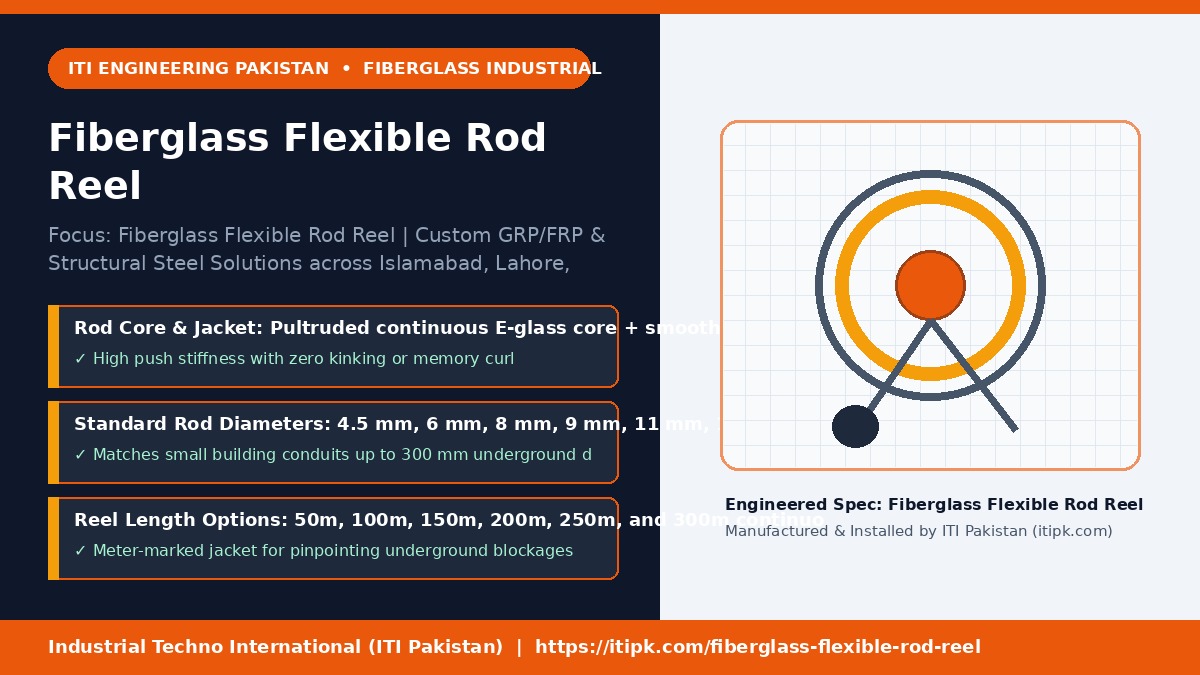
What Are Fiberglass Flexible Rod Reel and Why Are Buyers in Pakistan Switching to Engineered Solutions?
Direct Answer: Compared with unverified bazaar alternatives or slow masonry builds, factory-engineered Fiberglass Flexible Rod Reel cut on-site installation time by up to 50% while eliminating rust, water seepage, and structural fatigue. Across Islamabad, Lahore, Karachi, Rawalpindi, and Nationwide Telecom/Power Projects, facility owners and consultants specify FRP cable duct rodder Pakistan and underground cable pulling rod to protect capital budgets over a 25-year lifecycle.
Cheap hollow plastic pipes collapse after 20 meters of pushing, while bare steel spring wire coils into tangled knots on the street, scratches existing optical fibers inside occupied ducts, and conducts lethal voltage. By utilizing a high glass-to-resin ratio (>75% continuous unidirectional E-glass rovings) inside a slick polymer sheath, our fiberglass flexible rod reel pushes smoothly through multiple 90-degree conduit sweeps without buckling, while the heavy-duty ITI steel reel cage includes a feed-eye guide and hand brake to control recoil energy safely. When projects also require complementary systems like fiberglass electric enclosure boxes or industrial fiberglass grating, coordinating engineering specs upfront guarantees matching thermal expansion and wind-load safety.
When facility managers in Islamabad, Lahore, Karachi, Rawalpindi, and Nationwide Telecom/Power Projects compare lifecycle costs, the difference between bazaar fabrication and engineered manufacturing shows up within two seasons. Industrial Techno International (ITI Engineering) serves Pakistan as a trusted partner for Glass Reinforced Plastic (GRP/FRP) molding and structural steel fabrication—covering fiberglass flexible rod reel, daylighting panels, storage tanks, guard cabins, and clear-span steel sheds from CAD design to site erection.
What Technical Specifications Should You Verify Before Ordering Fiberglass Flexible Rod Reel?
Direct Answer: Before issuing a purchase order for Fiberglass Flexible Rod Reel, verify six core metrics: structural material grade, UV/corrosion surface barrier thickness, load-bearing gauge or gsm weight, thermal rating, fastener specification, and dimensional tolerances. Locking these into your BOQ prevents underweight substitutions on fiberglass fish tape reel.
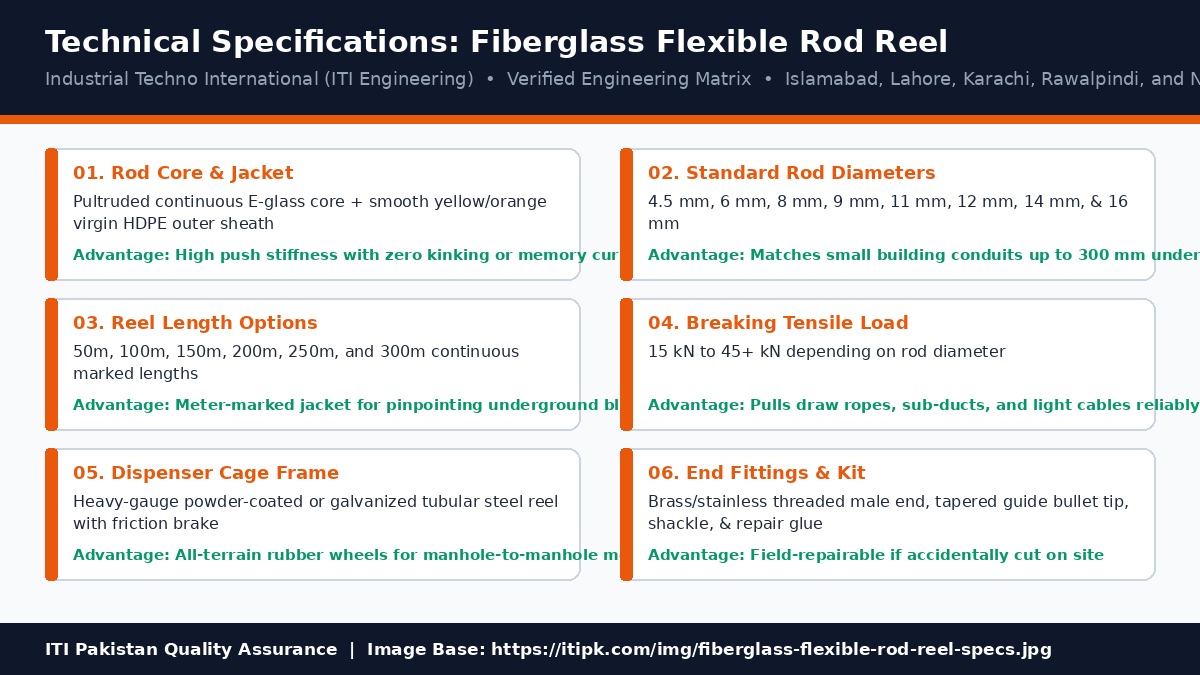
| Engineering Parameter | ITI Engineering Standard Specification | Operational & Buyer Advantage |
|---|---|---|
| Rod Core & Jacket | Pultruded continuous E-glass core + smooth yellow/orange virgin HDPE outer sheath | High push stiffness with zero kinking or memory curl |
| Standard Rod Diameters | 4.5 mm, 6 mm, 8 mm, 9 mm, 11 mm, 12 mm, 14 mm, & 16 mm | Matches small building conduits up to 300 mm underground ducts |
| Reel Length Options | 50m, 100m, 150m, 200m, 250m, and 300m continuous marked lengths | Meter-marked jacket for pinpointing underground blockages |
| Breaking Tensile Load | 15 kN to 45+ kN depending on rod diameter | Pulls draw ropes, sub-ducts, and light cables reliably |
| Dispenser Cage Frame | Heavy-gauge powder-coated or galvanized tubular steel reel with friction brake | All-terrain rubber wheels for manhole-to-manhole mobility |
| End Fittings & Kit | Brass/stainless threaded male end, tapered guide bullet tip, shackle, & repair glue | Field-repairable if accidentally cut on site |
The mechanics of high-tensile composite rod materials explain why wall thickness and reinforcement density are non-negotiable when evaluating bids for telecom fiber pulling rodder: because flexural stiffness scales with the cube of thickness, a 15% thinner section loses nearly 40% of its bending resistance. ITI Engineering documents exact millimeter gauges and resin systems on every batch, whether ordered standalone or integrated with heavy reel cage steel fabrication.
How Does Composite Laminate Chemistry Determine Real-World Lifespan?
Not all fiberglass performs equally—a lesson many buyers in Islamabad, Lahore, Karachi, Rawalpindi, and Nationwide Telecom/Power Projects learn when a cheap unit turns chalky within two summers. When specifying Fiberglass Flexible Rod Reel or comparing quotes for FRP cable duct rodder Pakistan, longevity depends on the three-layer GRP cross-section: a 400–600 micron UV-stabilized NPG isophthalic gelcoat on the outside, a fine surface veil, and alternating plies of virgin E-glass chopped strand mat (300–450 gsm) and woven roving (600 gsm). While chopped mat prevents inter-laminar shear across underground cable pulling rod and fiberglass fish tape reel, continuous woven roving acts like internal rebar against wind uplift and hail impact. Unlike bazaar fabricators who dilute orthophthalic resin with brittle calcium carbonate chalk filler, ITI Engineering uses pure thermoset resins that never peel or crack.
How Do Thermal Expansion and Monsoon Moisture Affect Installation?
Across Islamabad, Lahore, Karachi, Rawalpindi, and Nationwide Telecom/Power Projects, surface temperatures swing from winter frost to over 52°C in June. High-expansion plastics like PVC or thin polycarbonate elongate screw holes and break seals, whereas glass-reinforced composites in our Fiberglass Flexible Rod Reel expand at nearly the same low rate as structural steel. When our teams integrate polyurethane (PU) foam cores or steel mounting plates for telecom fiber pulling rodder and non conductive conduit rod, every insert is fully encapsulated in resin so monsoon moisture never wicks inside.
Where Are Fiberglass Flexible Rod Reel Used Most Effectively Across Pakistan?
Direct Answer: Across Pakistan’s industrial estates, commercial plazas, housing societies, and infrastructure camps, Fiberglass Flexible Rod Reel are deployed wherever owners need weather immunity, fast installation, and low lifecycle cost—from coastal Karachi and Port Qasim to high-heat corridors in Lahore, Faisalabad, Multan, and Hattar.
- Application 1: Telecom FTTH (Fiber-to-the-Home) and metro backbone optical cable pulling between underground manholes.
- Application 2: Underground 11kV/33kV power cable duct rodding and draw-rope threading in modern housing societies.
- Application 3: Municipal sewer, storm-drain, and industrial pipeline blockage location and CCTV camera guiding.
- Application 4: High-rise commercial building electrical riser and sub-floor conduit wiring.
Field Execution: Upgrading Facilities Without Production Downtime
In a typical facility upgrade in Islamabad, Lahore, Karachi, Rawalpindi, and Nationwide Telecom/Power Projects, operations teams must install Fiberglass Flexible Rod Reel without halting daily shifts. Because ITI Engineering pre-fabricates modules in our factory with pre-drilled flanges and UV-cured finishes, site erection is a fast bolted assembly often completed alongside telecom project portable site offices and telecom site security cabins. Moreover, our non conductive conduit rod need only a periodic water rinse rather than annual rust scraping or repainting.
How Much Do Fiberglass Flexible Rod Reel Cost in Pakistan and What Drives the Price?
Direct Answer: Pricing for Fiberglass Flexible Rod Reel in Pakistan depends on four variables: laminate or steel thickness (weight per square meter), resin or alloy grade, span complexity, and supply-only versus turnkey installation. Industrial Techno International (ITI Engineering) provides transparent itemized BOQs for FRP cable duct rodder Pakistan and fiberglass fish tape reel.
- Cost Driver 1: Rod diameter (6 mm for short small conduits vs. 11–14 mm for 250-meter heavy manhole runs).
- Cost Driver 2: Total continuous rod length (100m, 150m, 200m, or 300m) and meter-marking printing.
- Cost Driver 3: Heavy-duty wheeled steel stand with hand brake versus compact hand-carried mini-reel.
- Cost Driver 4: Accessory kit (swivel pulling eyes, roller guides, flexible leader tips, and splice couplings).
Pre-Delivery Inspection Checklist
Before approving site unloading for underground cable pulling rod, verify digital caliper wall thickness, check surface gelcoat or primer continuity, inspect internal stiffener ribs, confirm EPDM-sealed fasteners, and match the batch against your signed factory golden sample.
How Should Fiberglass Flexible Rod Reel Be Installed and Maintained?
Direct Answer: A 25+ year lifespan with Fiberglass Flexible Rod Reel requires leveled supports, EPDM-gasketed bolting, clear drainage, and a bi-annual water rinse. Reference continuous glass fiber pultrusion technology and high-tensile composite rod materials alongside ITI submittal tables for structural verification.
Frequently Asked Questions (FAQs) About Fiberglass Flexible Rod Reel
1. Which diameter fiberglass flexible rod reel should I choose for underground telecom manholes?
For standard manhole-to-manhole distances of 100 to 250 meters in 100 mm or 110 mm HDPE ducts, an 11 mm or 12 mm diameter fiberglass rodder is the industry standard in Pakistan. For shorter building conduits under 80 meters, 6 mm or 8 mm works best.
2. What happens if a fiberglass duct rod accidentally breaks during field work?
Unlike steel wire that becomes useless once kinked, a fiberglass rod is easily repaired in the field within 15 minutes using a brass splice coupling sleeve and two-part epoxy adhesive included in our maintenance kit.
3. Is it safe to push a fiberglass flexible rod into a conduit that already contains live electrical cables?
Yes. The pultruded glass-fiber core and HDPE outer sheath are non-conductive, and the smooth rounded brass bullet nose glides past existing cable jackets without slicing their insulation.
4. Does ITI Engineering deliver and install Fiberglass Flexible Rod Reel across Pakistan?
Yes, we manufacture in-house and install across Islamabad, Lahore, Karachi, Rawalpindi, and Nationwide Telecom/Power Projects and industrial estates nationwide, providing CAD quotes for FRP cable duct rodder Pakistan within 48 hours.
Conclusion: Partner with ITI Engineering for Proven Fiberglass Flexible Rod Reel in Pakistan
Selecting a manufacturer for Fiberglass Flexible Rod Reel comes down to verified resin and steel chemistry, honest thickness tolerances, and safe site execution. Whether you need FRP cable duct rodder Pakistan, telecom fiber pulling rodder, non conductive conduit rod, or turnkey integration with fiberglass electric enclosure boxes and industrial fiberglass grating, Industrial Techno International (ITI Engineering) delivers factory-direct solutions built for decades of Pakistani service. Contact ITI Pakistan today for material samples, shop drawings, and a custom quote.
Leave a Reply