
Fiberglass Domes: Complete Buyer, Engineering & Installation Guide in Pakistan
Fiberglass Domes give engineers, facility managers, and commercial buyers across Lahore, Islamabad, Multan, and Karachi a high-strength, weather-proof solution built for Pakistan’s toughest thermal and industrial conditions. When a mosque committee in Multan or a commercial plaza architect in Islamabad needs a monumental central dome without adding forty tons of dead load to the roof ring beam, traditional reinforced concrete quickly becomes a structural headache. Fiberglass domes (also engineered as Glass Reinforced Plastic or GRP domes) are precision-molded composite roof structures that weigh up to 80% less than conventional concrete or masonry domes while delivering superior weatherproofing, UV stability, and seismic safety. Manufactured in modular interlocking segments by Industrial Techno International (ITI Engineering) across Pakistan, these domes eliminate shuttering delays, prevent hairline water seepage, and retain their high-gloss gelcoat finish for decades under intense South Asian sun. By combining proven principles of glass-fiber reinforced composite materials with precision local fabrication, projects that specify GRP dome manufacturer Pakistan gain decades of dependable service without recurring repair shutdowns.
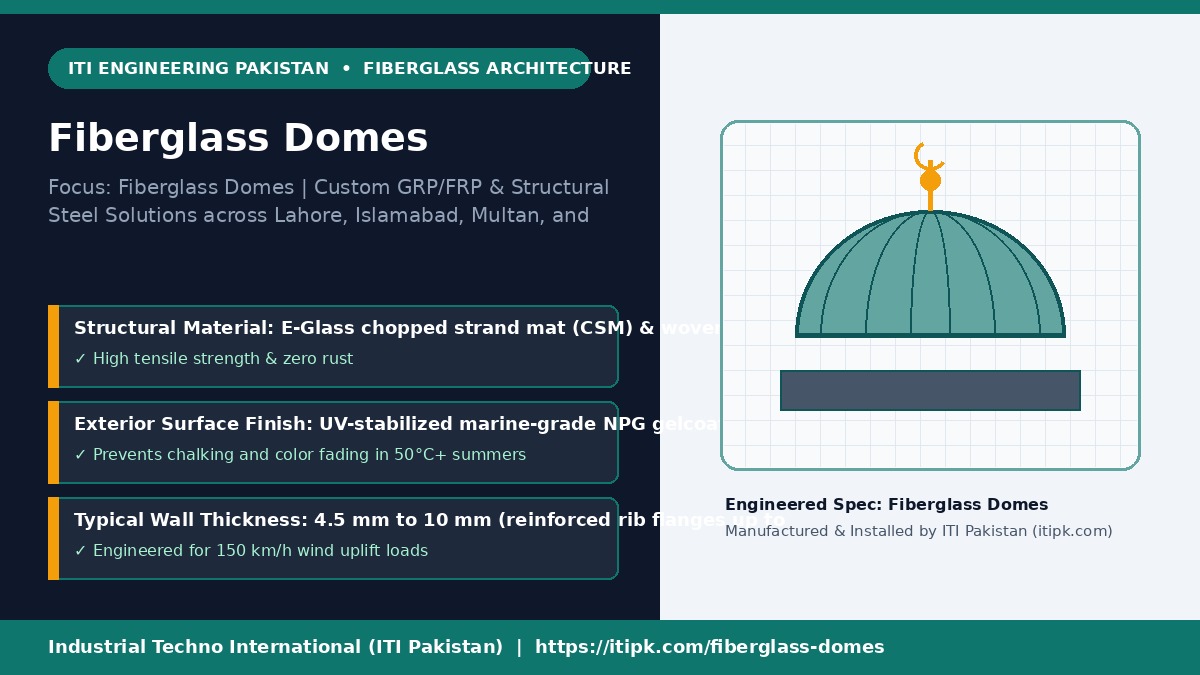
What Are Fiberglass Domes and Why Are Buyers in Pakistan Switching to Engineered Solutions?
Direct Answer: Compared with unverified bazaar alternatives or slow masonry builds, factory-engineered Fiberglass Domes cut on-site installation time by up to 50% while eliminating rust, water seepage, and structural fatigue. Across Lahore, Islamabad, Multan, and Karachi, facility owners and consultants specify GRP dome manufacturer Pakistan and fiberglass mosque domes to protect capital budgets over a 25-year lifecycle.
Cast-in-place concrete domes require complex curved timber or steel shuttering that takes weeks to erect and frequently leaves honeycombing at the haunches. Within two monsoon cycles, thermal expansion creates micro-fissures that ruin expensive interior calligraphy and plasterwork. At ITI Engineering, large-diameter fiberglass domes are fabricated using precision female molds with internal radial stiffening flanges. Each pie-shaped petal is bolted from the interior through pre-drilled galvanized or stainless steel gusset plates and sealed with high-modulus polyurethane mastic. When projects also require complementary systems like fiberglass skylight sheets for roofs or fiberglass roof tiles, coordinating engineering specs upfront guarantees matching thermal expansion and wind-load safety.
Across industrial zones and urban centers in Lahore, Islamabad, Multan, and Karachi, project engineers frequently see off-the-shelf building products fail early when local heat and monsoon extremes are ignored. At Industrial Techno International (known across the industry as ITI Engineering or ITI Pakistan), our teams manufacture fiberglass domes alongside custom fiberglass domes, storage tanks, FRP gratings, portable guard cabins, cold-chain boxes, and pre-engineered steel structures under one roof—so every flange, resin layer, and steel support fits together seamlessly.
What Technical Specifications Should You Verify Before Ordering Fiberglass Domes?
Direct Answer: Before issuing a purchase order for Fiberglass Domes, verify six core metrics: structural material grade, UV/corrosion surface barrier thickness, load-bearing gauge or gsm weight, thermal rating, fastener specification, and dimensional tolerances. Locking these into your BOQ prevents underweight substitutions on architectural FRP domes.
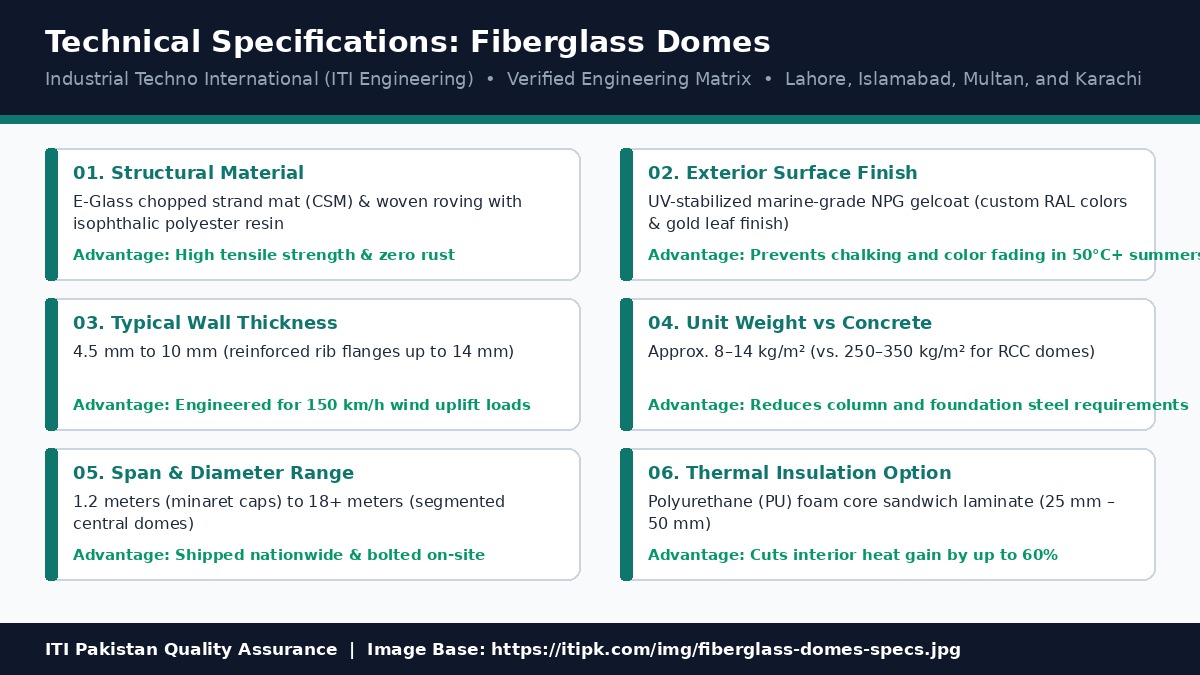
| Engineering Parameter | ITI Engineering Standard Specification | Operational & Buyer Advantage |
|---|---|---|
| Structural Material | E-Glass chopped strand mat (CSM) & woven roving with isophthalic polyester resin | High tensile strength & zero rust |
| Exterior Surface Finish | UV-stabilized marine-grade NPG gelcoat (custom RAL colors & gold leaf finish) | Prevents chalking and color fading in 50°C+ summers |
| Typical Wall Thickness | 4.5 mm to 10 mm (reinforced rib flanges up to 14 mm) | Engineered for 150 km/h wind uplift loads |
| Unit Weight vs Concrete | Approx. 8–14 kg/m² (vs. 250–350 kg/m² for RCC domes) | Reduces column and foundation steel requirements |
| Span & Diameter Range | 1.2 meters (minaret caps) to 18+ meters (segmented central domes) | Shipped nationwide & bolted on-site |
| Thermal Insulation Option | Polyurethane (PU) foam core sandwich laminate (25 mm – 50 mm) | Cuts interior heat gain by up to 60% |
The mechanics of classical dome oculus and cupola engineering explain why wall thickness and reinforcement density are non-negotiable when evaluating bids for lightweight roof domes: because flexural stiffness scales with the cube of thickness, a 15% thinner section loses nearly 40% of its bending resistance. ITI Engineering documents exact millimeter gauges and resin systems on every batch, whether ordered standalone or integrated with structural steel fabrication.
How Does Composite Laminate Chemistry Determine Real-World Lifespan?
Not all fiberglass performs equally—a lesson many buyers in Lahore, Islamabad, Multan, and Karachi learn when a cheap unit turns chalky within two summers. When specifying Fiberglass Domes or comparing quotes for GRP dome manufacturer Pakistan, longevity depends on the three-layer GRP cross-section: a 400–600 micron UV-stabilized NPG isophthalic gelcoat on the outside, a fine surface veil, and alternating plies of virgin E-glass chopped strand mat (300–450 gsm) and woven roving (600 gsm). While chopped mat prevents inter-laminar shear across fiberglass mosque domes and architectural FRP domes, continuous woven roving acts like internal rebar against wind uplift and hail impact. Unlike bazaar fabricators who dilute orthophthalic resin with brittle calcium carbonate chalk filler, ITI Engineering uses pure thermoset resins that never peel or crack.
How Do Thermal Expansion and Monsoon Moisture Affect Installation?
Across Lahore, Islamabad, Multan, and Karachi, surface temperatures swing from winter frost to over 52°C in June. High-expansion plastics like PVC or thin polycarbonate elongate screw holes and break seals, whereas glass-reinforced composites in our Fiberglass Domes expand at nearly the same low rate as structural steel. When our teams integrate polyurethane (PU) foam cores or steel mounting plates for lightweight roof domes and custom fiberglass cupola, every insert is fully encapsulated in resin so monsoon moisture never wicks inside.
Where Are Fiberglass Domes Used Most Effectively Across Pakistan?
Direct Answer: Across Pakistan’s industrial estates, commercial plazas, housing societies, and infrastructure camps, Fiberglass Domes are deployed wherever owners need weather immunity, fast installation, and low lifecycle cost—from coastal Karachi and Port Qasim to high-heat corridors in Lahore, Faisalabad, Multan, and Hattar.
- Application 1: Community and Jamia Mosques requiring golden, white, or emerald ribbed onion domes and matching minaret caps.
- Application 2: Shopping malls and corporate atriums in Lahore and Karachi using translucent daylighting domes to cut daytime artificial lighting bills.
- Application 3: Educational campuses and heritage buildings replacing deteriorating masonry cupolas without strengthening old load-bearing walls.
- Application 4: Industrial process plants needing corrosion-proof vapor containment covers over circular clarifiers and storage basins.
Field Execution: Upgrading Facilities Without Production Downtime
In a typical facility upgrade in Lahore, Islamabad, Multan, and Karachi, operations teams must install Fiberglass Domes without halting daily shifts. Because ITI Engineering pre-fabricates modules in our factory with pre-drilled flanges and UV-cured finishes, site erection is a fast bolted assembly often completed alongside flat and molded fiberglass sheets and warehouse shelter manufacturing. Moreover, our custom fiberglass cupola need only a periodic water rinse rather than annual rust scraping or repainting.
How Much Do Fiberglass Domes Cost in Pakistan and What Drives the Price?
Direct Answer: Pricing for Fiberglass Domes in Pakistan depends on four variables: laminate or steel thickness (weight per square meter), resin or alloy grade, span complexity, and supply-only versus turnkey installation. Industrial Techno International (ITI Engineering) provides transparent itemized BOQs for GRP dome manufacturer Pakistan and architectural FRP domes.
- Cost Driver 1: Dome diameter, rise-to-span profile (hemispherical vs. pointed Islamic arch), and total surface area.
- Cost Driver 2: Single-skin laminate versus insulated double-skin polyurethane core construction for air-conditioned halls.
- Cost Driver 3: Translucent daylighting panels versus opaque pigmented gelcoat or metallic gold polyurethane topcoats.
- Cost Driver 4: Internal steel ring-beam support frame fabrication and crane erection height at the project site.
Pre-Delivery Inspection Checklist
Before approving site unloading for fiberglass mosque domes, verify digital caliper wall thickness, check surface gelcoat or primer continuity, inspect internal stiffener ribs, confirm EPDM-sealed fasteners, and match the batch against your signed factory golden sample.
How Should Fiberglass Domes Be Installed and Maintained?
Direct Answer: A 25+ year lifespan with Fiberglass Domes requires leveled supports, EPDM-gasketed bolting, clear drainage, and a bi-annual water rinse. Reference glass-fiber reinforced composite materials and classical dome oculus and cupola engineering alongside ITI submittal tables for structural verification.
Frequently Asked Questions (FAQs) About Fiberglass Domes
1. How long does a fiberglass dome last in Pakistan’s extreme summer heat?
A properly formulated fiberglass dome built with UV-inhibited isophthalic gelcoat easily lasts 30 to 40 years in Pakistan. Unlike ordinary plastic that turns brittle, glass-reinforced thermoset resin maintains structural rigidity from freezing northern winters in Abbottabad to 50°C summer peaks in Sindh, requiring only an occasional wash or a fresh polyurethane topcoat after 12 to 15 years.
2. Can a large fiberglass dome survive heavy windstorms and earthquakes?
Yes. Because fiberglass domes have an exceptionally high strength-to-weight ratio and low seismic mass, they exert minimal horizontal shear during earthquakes compared to heavy concrete domes. ITI Engineering reinforces multi-segment domes with internal radial ribs and structural steel base rings engineered for high wind-load zones.
3. How are large-diameter domes transported and installed on high roofs?
Domes wider than 3 meters are molded in precision interlocking radial segments. The segments are stacked compactly on a flatbed truck, hoisted to the roof using a light mobile crane or gin pole, bolted together along internal flanges with EPDM gaskets, and chemically sealed so the exterior seam is completely watertight.
4. Does ITI Engineering deliver and install Fiberglass Domes across Pakistan?
Yes, we manufacture in-house and install across Lahore, Islamabad, Multan, and Karachi and industrial estates nationwide, providing CAD quotes for GRP dome manufacturer Pakistan within 48 hours.
Conclusion: Partner with ITI Engineering for Proven Fiberglass Domes in Pakistan
Selecting a manufacturer for Fiberglass Domes comes down to verified resin and steel chemistry, honest thickness tolerances, and safe site execution. Whether you need GRP dome manufacturer Pakistan, lightweight roof domes, custom fiberglass cupola, or turnkey integration with fiberglass skylight sheets for roofs and fiberglass roof tiles, Industrial Techno International (ITI Engineering) delivers factory-direct solutions built for decades of Pakistani service. Contact ITI Pakistan today for material samples, shop drawings, and a custom quote.
Leave a Reply